
16.5.12


pirates
Right in the midst of writing my thesis I am bogged down in discourse analysis and scrabbling for the golden thread of exactly why I chose this topic.
Why am I writing about ACTA and Freedom of Expression?
Oh yeah. Because of what he says.
Because those kids aren't pirates.
8.4.12
A Crude Inquiry
Recently I took part in the Oxford Human Rights Film Festival by watching the award winning documentary Crude. It got me thinking about many things: indigenous peoples rights, the Northern Americanisation of issues, the strength of conviction and most prominently, the power of inquiry.
In Crude we see a group of Indigenous and colonial Ecuadorian people persecuting Texaco for pollution and destruction of the environment; explicitly the area in which the people live. It is a circus of passing on responsibility, vivid corruption and media games all to try and seek some kind of renumeration or compensation, and all at the cost of many years and many more dollar bills.
Now, I am aware of the importance of law. Studying Human Rights through an interdisciplinary lens has underlined the significant requirement of an international legal system with functioning international law, ratified treaties, an overarching monitoring body, jurisprudence and, most significantly, the gravity of protection and restitution. Having mechanisms through which to challenge states, individuals and corporations is essential to human rights. Towards both living life safely and in creating a culture that can help stop future violations.
During this film I had a moment of clarity. I considered what Foucault would say about these good people struggling against the evil corporations. There is a cycle in indigenous communities under threat: of needing to play the big international game, of proving indigeneity, topped by the imposed demand to utilize the dominant powers' tools in the fight.
I imagine Foucault would look at this use of state apparatus and suggest that the method of Inquiry as a tool of the dominant power was still gripping as strongly and obnoxiously as ever. In Truth and Juridicial Forms Foucault analyses the development of inquiry from Greek society to the Western legal system as we now know it. Foucault explains how inquiry has become a way of exercising power, authenticating truth and perpetuating this way of seeing things.
The adoption of inquiry in society is seen by Foucault as a 'political transformation' - and a rather distinctly Western one at that. Rather than being an outcome of the development of rational thought, inquiry became a tool for the dominant power to reorganise judicial practices to be more than between two individuals, and to involve a third party: the state. Now, when a wrong is committed, it not only is a wrong against an individual, but also against the state. The state has managed to appropriate the entire judicial system.
This method of inquiry is still used today. Those with the greatest power and knowledge are those that conduct inquiry, thus, perpetuating a discourse that is in favour of the dominant ideology and the state. Here, the state is making the indigenous community play it's game. It is providing the only legitimate method of inquiry or way of gaining the 'Truth' of a situation. As Foucault argues that “we cannot exercise power except through the production of truth”.
The dominant power (the Western world) is flexing it's methods of 'truth discovery' as the only legitimate way of providing answers, forcing the indigenous peoples to become part of the system that oppresses them.
The fog of neo-colonialism lingered long in the background of this documentary, and as an afterthought I had to quietly reassure myself that 'indigenous' is a Western term; it was the colonisers who were so keen to differentiate between 'them' and 'us'. And as I left the cinema I wondered if we will ever see a world in which indigenous peoples can present their own truth, and not be overshadowed by the protocol of the system.
7.4.12
covert trowels
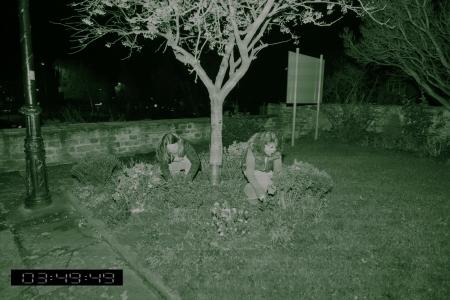
A couple of weeks ago my good pal gt and I took part in some guerilla gardening.
And what can I say.
It was a lavender scented gem.
It took place on a mild March evening full of smiles and manure and mead and butterless cookies with strangers, exchanging stories and trowels whilst dragging dead shrubs about the cycle paths. It was one of the best evenings I have had in a long time. Helping out in a covert operation with people living in the community to plant little seedlings that had a whole future ahead of them, whilst keeping a look out for the po-po and sneaking sips of cloudy wiltshire cider is just the way I want to spend my Friday nights.
If you want to hear more about our evening, visit the guerilla gardening site here (notice the shout out to the welsh mead bearing lovely couple - didn't want to correct on facts after such a nice endorsement...)
And if you want to start your own... here are some helpful tips.
The only advice I can offer is that you bring a change of gloves and shoes (and possibly trousers) if you don't want to end up smelling like horse shit for the rest of the evening in the pub.
(Learnt from first hand experience.)
23.3.12
Surplus for change
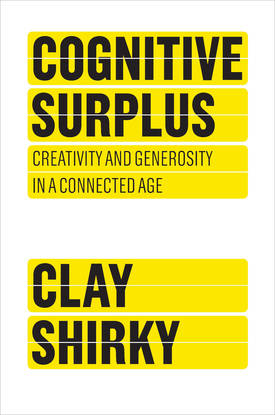
Clay Shirky; Cognitive Surplus
I picked up this book
on the premise that the subheading “Creativity and Generosity in a
Connected Age” would help me be more resourceful and productive. It
resulted in a fascinating read that I found myself bringing up in
conversation time and time again. I am not sure if I feel more
productive now I have finished, but I feel as thought I understand a little
bit better exactly why things they are a-changing.
Shirky writes in an
incredibly concise way, throwing in clear and enlightened insights
consistently, not only explaining how and why, but leaving your
thoughts reeling in the wake of what he has just said.
The story of Cognitive
Surplus covers just what we do with our free time since the occurance
of the big old world wide web. Previously us citizens were seen
simply as passive consumers of television, singularly and separately
in our spare time. With the revolutionary nature of the internet we
saw a change in this consumption. People began reaching for the
mouse, interacting, as pointed out by Shirky, through varied avenues
such as Lolcatz or couchsurfing to the communities of open source
technology programming. Shirky discusses how we use our free time and
how it has changed due to the burst of social media over the past few
years, now allowing interconnectivity on new levels.
For me, I felt my eyes
sparkle. What if it's true, and all of this free time can result in a
better, more communal society? At the moment, in the UK and across
Europe, and even the world, we are seeing financial crisis' left
right and centre. Younger and older people alike are finding
themselves jobless. Under 25 employment is at a record high in the
UK. And all of these young people have grown up in the age of the
internet, watching the technological revolution unfold. We have
already seen the importance of social media in various uprisings
across the world; from the revolution in Egypt to the formation of
Occupy globally. The internet, and more specifically social media is
becoming integral in organising human beings into value laden action.
Perhaps now we will
see a further politicisation of the younger generations; those sat at
home, jobless, full of fury and promise, constantly reaching for the
mouse to see what can be done.
8.3.12
International Women's Day
Today I have posted a barrage of amazing and wonderful posts and tweets and messages about some brilliant people and ideas that have helped emancipate women, inspire all and encourage change. In no specific order.
Andrew Gibson; swingset. Via my friend Nick.
Angela Davis and Yuri Kochiyama: Mountains that take wing. Via my friend Gav.
Feminists. Everywhere. Past and present. Via UK Feminista and London Feminist Network

Robin Hood Tax's wonderful posts on women in the financial sector.
Andrew Gibson; swingset. Via my friend Nick.
Angela Davis and Yuri Kochiyama: Mountains that take wing. Via my friend Gav.
Feminists. Everywhere. Past and present. Via UK Feminista and London Feminist Network
Robin Hood Tax's wonderful posts on women in the financial sector.
"Happy International Women's Day. Marion is leading celebrations here in Sherwood. And a fact for the day: In the final report of the Financial Crisis Inquiry Commission of the US Treasury the words "she", "woman" or "her" do not appear once in its 662 pages. It is a book, like most historical tragedies, written about the follies and hubris of men."Girls on bikes; How the Bicycle empowered Women. By Maria Popover @brainpicker
Let me tell you what I think of bicycling. I think it has done more to emancipate women than anything else in the world. I stand and rejoice every time I see a woman ride by on a wheel.” ~ Susan B. Anthony, 1896Nina Simone: I've Got Life
There is something i've got, nobody can take it away...Ani Difranco: Fuel
Beneath the good and the kind and the stupid and the cruelThere's a fire that's just waiting for fuel
17.2.12
Utopian pathways
Paths Through Utopias from Ed Murphy on Vimeo.
I encountered upon this documentary when I was looking through the listings of my favourite independent cinema in the world, in my hometown of Bristol; the cube.
It seemed like the embodiment of some conversations that gt and I have been having of late, concerning the relationship between activism and living life the way in which you believe; how you hold your values.
Turns out it is much more than that. It is beautiful, sentimental, critical and inspiring.
But I won't say any more, because you might not want what I want. But then again- you might.
Highly recommended.
27.1.12

25.1.12
30.11.11
27.11.11
more occupy
For a look at how many economists feel now about the occupy movement,
watch this.
(shared by @caspertk)
Occupy Economics from Softbox on Vimeo.
25.11.11
ai wei wei
I have just finished a great little book: Ai Weiwei Speaks with Hans Ulrich Obrist.
I want to write about it, but there is a milieu of things I could say about Ai weiwei.
Mostly in regards to how the Chinese government have treated this 'dissident' earlier this year. But I will focus on this book as a window into the artist's mind.
This little snippet of weiwei is fascinating. His personality is huge, the way he sees life is fluid and unique and he speaks with stark honesty. Especially in regards to China.
weiwei's sunflower seeds was showing in the turbine hall of the Tate Modern when I started working there earlier this year. It is breathtaking. And the film that accompanies the installation is a beautiful story of how and why this piece came about. In fact, I almost liked it more than the tiny hand painted seeds themselves.
I think the thing that makes weiwei so incredible is the way in which he sees the world. Art is an attitude, a way of thinking, or a way of life. His insights into the impact of the Chinese cultural revolution, his fathers experiences, his relationship with books and architecture and blogging are completely fascinating.
"On the one hand I take art very seriously, but the production has never been so serious, and most of it is an ironic act. But anyhow, you need traces, you need people to be able to locate you, you have a responsibility to say what you have to say and to be wherever you should be. You're part of the misery and you can't make it more or less. You're still part of the whole fascinating condition here."
"And I have one regret: I feel sorry that I can't write well. That's the skill that I value the most. I think that, if I could write well, I'd give up my art for writing. For me, it is the most beautiful and effective way to illustrate my thinking"
Definitely worth a read.
24.11.11


the human library
Last month a couple of friends and myself made a human library.
We were inspired by some discussion groups we had been holding for those on our MA and on our Indigenous Studies course. It was the most incredible experience to hear about some of my friends stories. Stories of difficult childhoods, indigenous struggles, living through war, having children, fighting against corrupt or oppressive regimes. Stories that could have gone untold, and many stories that needed to be shared.
It was an incredible experience for which I am hugely thankful.
So we recruited some books from our group (and a few more from elsewhere), trained them, helped them identify their book titles and contents page and then put them on a shelf for others to browse and select.
It was a great success by all means.
Some books were read 9 times in the 4 hours our library was open, over 50 people attended and all of the books (more or less) were returned in a healthy condition, buzzing from the experience of sharing their stories.
Here is a little video we put together for the event:
Many thanks out to everyone who took part in the event and all of the student groups and individuals that supported us.
Not bad for two weeks notice. not bad at all. Well done team library!
Remember, don't judge a book by its cover... especially if it isn't a book.
22.11.11
dark side of the lens
this.
is beautiful.
Hear more about why and how and who made this little piece of magic here at the most excellent
do lectures.
is beautiful.
Hear more about why and how and who made this little piece of magic here at the most excellent
do lectures.
6.11.11
confiscated life
Extract by Don Delillo on Nobel Peace Prize winner Liu Xiaobo
What happens to the writer caught in the tide of round-the-clock surveillance, enforced isolation, detention without trial?
Think of a man alone in a room. This is the writer's classic condition, cruelly extended when the state locks the door to the room. Think of the writer in opposition, the man who writes against power, who writes against the coiled mechanism of the state and the entire apparatus of total assimilation.
It's the nature of language to pitch itself against the smothering oneness of the state. Words want to be free. Lui Xiaobo's crime is called "an incitement to subvert state power." This is an administrative term for the exercise of free speech - the very activity, Lui writes, that is the mother of truth.
Writers everywhere tend to feel a natural kinship, country to country, language to language. We write to be true to some urgency of self. We find identity in the lines of poetry we write, in the sentences and paragraphs of our novels and essays. We write to think ourselves into existence.
Sign the petition to free Lui Xiaobo here
bon iver
This was my other reason for being in Oslo. Bon Iver magic.
As I said on the night... I want to live inside their music forever.
And that is not an exaggeration.
I heart crescendos.
As I said on the night... I want to live inside their music forever.
And that is not an exaggeration.
I heart crescendos.
transit
This past weekend I went for a little trip down the entire breadth of this huge country to Oslo. It was my birthday, and my birthday plan entailed two things. The second being the Nobel Peace Center (the first to follow shortly).

The Peace centre is hands-down the best museum I have ever been to. The interactive Nobel peace prize winners room glowed brightly with numerous kindles detailing those awarded, their exploits and the reasons behind their importance. There was an interactive story book, an interactive children's room and the most fantastic interactive time line with quotes, videos, articles, pictures and a room full of enamoured american schoolchildren asking "But Liu Xiaobo is a criminal in China?".
It. was. great.
The first part of the museum was an exhibition of photography works by Espen Rasmussen a Norwegian photographer focusing on the plight of refugees, including a close up portrait of a young refugee living in Norway; Rahman. The pictures were fantastic, the captions honestly interesting and the portrayal of refugees was, for a change, not entirely grim and negative. It gave a slightly positive humanistic dimension to the experience of being a refugee showing a glimpse of family life in amongst the harrowing and shocking majority of the photographs.
Highly recommended.
Oo, there is also a great looking website for the Transit exhibition here.
Subscribe to:
Posts (Atom)