Showing posts with label information. Show all posts
Showing posts with label information. Show all posts
30.12.15


18.12.15
When life gives you lemons…

First published on Going Local Going Green and Medium.
When
life gives you lemons, don’t worry. Even if you can’t begin to imagine
what lemonade looks like, never mind what it might taste like, don't
worry. If you lose your lemons, it's okay - they are still out there
somewhere, and in all likelihood, they’ll turn back up on your doorstep
when you least expect them.
In 2015 I lost my lemons, so to speak. And when I say lemons, I really mean 'my shit'. The past 12 months have been full of ups and downs and roundabouts - a bit like Milton Keynes. It all began with Going Local Going Green.
So, now I’ve turned into one of those people who talks about lemons. There is a lot more to this, as you can imagine. I can feel my life changing every day. I’m trying to do the things that make me feel good more and to confront the things that don’t make me feel very good. I’m learning about what intention means. I feel like I’m a bit late to the mental health and wellbeing party, but I’m glad I’m getting there in my own time. I’m doing things like this; saying out loud the way that I’m feeling. It’s amazing and terrifying. There are still hard days and there always will be, but now I can allow myself to be honest with when I’m having these days and do the things I need to do to be kind to myself - whether it’s stretching my bones out or challenging my mind. I still find all this openness a minefield and I’m extremely thankful for my friends and family helping me to navigate through this. And I apologise in advance if I verbally vomit about any of this stuff, because I think it’s all brilliant and scary and I need all of your help to make sense of it all - and I hope I can help you in return.
Right now, my lemons are doing alright. I hope yours are too.
In 2015 I lost my lemons, so to speak. And when I say lemons, I really mean 'my shit'. The past 12 months have been full of ups and downs and roundabouts - a bit like Milton Keynes. It all began with Going Local Going Green.
On reflection
Going Local Going Green is this research project I’ve been working on looking at health, food, nature, economy, land use and food in the city of Bristol - not, as you may have thought, my lemons. As part of our Action Learning methodology we’ve had to meet once every four weeks or so to reflect on the past month and plan for the month ahead. This process is intense. It involves speaking for 20 - 30 minutes in a stream of consciousness about both the things we have achieved and would like to achieve, and also how we are feeling. In all of my 31 years of life I have never been in a situation like this before. To sit with 3 other people and to be given an opportunity to express how I feel about my life. The process began with speaking about work related to the research project, and it ended with a mini life crises. Being allowed an open and supportive space to express myself felt incredibly difficult at first. Although I like to think of myself as emotionally intelligent (or something along those lines) it turns out, when we started this back in April 2015, I was not. I was going through the motions but there was something blocking me, and this became more and more evident as the monthly sessions passed by. Some months I turned up hidden behind a stone cold wall - refusing to get any deeper than a list of actions and events for the past month, avoiding questions about emotions. One month I turned up and pretty much refused to speak because I felt so angry and sad. One member of the group who is much more learned in the ways of Action Learning said that this moment was when they thought they were either going to lose me, or break me. It turns out, I was ready to break. And break I did.Feeling my way
I had a bout of depression for around 6 weeks, with days full of inconsolable tears and a sense of hopelessness I haven’t felt since I was a teenager curled up on the bathroom floor. I felt as though I couldn’t see the way out of how I was feeling and started to worry that this is how I would feel forever. I started seeing a counsellor who practices gestalt psychotherapy - connecting me with my body and my feelings in a way I hadn’t been aware of before. Who knew you could just feel emotions? I’m such an analytical soul (I blame academia) with an ingrained internal process of; emotions turn up - analyse critically - put in box - file in psyche - never think about again. I didn’t realise that with emotion comes acceptance and responsibility. There is a sense of intention and self care - and most importantly an understanding of yourself and of other people. Who would have thought? Certainly not me 12 months ago.Pressure points
With this fresh look at my mental health, came a slow look at my physical health. I’ve been having migraines about once a month since my return from Mexico in March. I started seeing another therapist - an acupuncturist, to see if I could alleviate some of this pain. His work has also been around my emotional health, helping to ‘open up some of my channels’ which may have been seriously blocked since I was a wee bairn. Or at least since I was a teenager struggling to handle my emotions (the beginning of the box situation as above). Acupuncture has been a revelation to me. I don’t understand it. I know it works, because I can feel it. Different meridian points have made me feel different things. And the migraines are beginning to alleviate, which is incredible as they’ve been haunting me each month for the best part of a year now. How? I don't know. Sometimes you just need to trust that something works.Menstrual times
Closely associated with both of the above is my new found menstrual literacy. When I started blocking my own communication in Action Learning, and making a note of when my migraines came, I realised it’s all related to my menstrual cycle. So, as one of my Going Local Going Green pals suggested, I started looking into what this could mean in terms of my menstrual cycle and the changes that my body goes through each month. It would be fair to say this is sort of a positive pandora’s box for me. Everything has been flying out, but it hasn’t all been bad. It’s been one of the most profound experiences of my life. We live in these bodies yet we know so little about them. It turns out we’re cyclical beings in a cyclical world that is pretending to be linear (and wants us to pretend to be linear too). It’s complicated and completely simple at exactly the same time.So, now I’ve turned into one of those people who talks about lemons. There is a lot more to this, as you can imagine. I can feel my life changing every day. I’m trying to do the things that make me feel good more and to confront the things that don’t make me feel very good. I’m learning about what intention means. I feel like I’m a bit late to the mental health and wellbeing party, but I’m glad I’m getting there in my own time. I’m doing things like this; saying out loud the way that I’m feeling. It’s amazing and terrifying. There are still hard days and there always will be, but now I can allow myself to be honest with when I’m having these days and do the things I need to do to be kind to myself - whether it’s stretching my bones out or challenging my mind. I still find all this openness a minefield and I’m extremely thankful for my friends and family helping me to navigate through this. And I apologise in advance if I verbally vomit about any of this stuff, because I think it’s all brilliant and scary and I need all of your help to make sense of it all - and I hope I can help you in return.
Right now, my lemons are doing alright. I hope yours are too.
6.10.15
pale blue dot

"From this distant vantage point the earth might not seem of any particular interest. but for us, it's different. Consider again that dot. That's here. That's home. That's us.
On it, everyone you love, everyone you know, everyone you ever heard of - every human being who ever was, lived out their lives. The aggregate or joy and suffering, thousands of confident religions ideologies and economic doctrines.
Every hunter and forager, every hero and coward, every creator and destroyer of civilisation, every king and peasant, every young couple in love, every mother and father, hopeful child, inventor and explorer.
Every teacher of morals, every corrupt politician. Every superstar, every supreme leader. Every saint and sinner in the history of our species lived there, on the mode of dust, suspended in a sunbeam.
The earth is a very small stage in a vast cosmic arena.
Think of the rivers of blood spilled by all those generals and emperors so that in glory and triumph they could become the momentary masters, of a fraction, of a dot."
Carl Sagan. Pale Blue Dot.
15.5.15
Hacking it out at the farm
New entrants to farming in Britain are often faced with a long list of challenges before they even put their wellies on. Defra’s 2013 report, Future of Farming Review, details a vast array of barriers faced by new entrants to farming, and highlights the shocking figure that only 8% of British farmers are first generation.
Across the pond in the United States, a different phenomenon is occurring: the arrival of the Greenhorns. In farming terms, a greenhorn is a novice or new entrant into agriculture, and this grass-roots group aims to help them. The Greenhorns have been making waves with their 2014 documentary on young farmers, and they are helping to change the landscape of field-to-fork farming by using technology to organise and up-skill new farmers. Recently, the Greenhorns have developed a specific tool to help connect the diaspora of new farmers spread across the United States – it’s called the ‘Farm Hack’, and it has now arrived in the UK.
What’s a ‘Farm Hack’?
‘Farm Hack’ is a concept coined by the Greenhorns. Think ‘i-fixit’ combined with Wikipedia. Lots of problems – and lots of solutions – all on an open-source, easily accessible platform that allows members to interact, debate and build on each other’s ideas. Although the term ‘hack’ evokes images of computers with Matrix-style numbers flashing across the screen and a virus eating your computer from the inside out, it actually has myriad meanings. These range from the ability to cope successfully with something to breaking up the surface of soil. In recent years hack has also come to mean a congregation of people (either online or offline) aiming to take action or work together to solve a problem.
Taking action and problem solving is exactly what occurred on a sunny spring day last month at Ruskin Mill in Gloucestershire at an event organised by the Landworkers’ Alliance. A group of farmers – some new entrants, some old hands – gathered together to find solutions to their shared problems. From Fife to Devon and Norwich to Pembrokeshire, farmers and those with technical expertise travelled from far and wide to share their knowledge and see how they could help one another address a wide range of issues faced on the farm.
UK Farm Hack #1
The Farm Hack was launched by Severine von Tscharner Flemming, the founder of the Greenhorns, with guests of honour L’Atelier Paysan, an innovative group of French farmers, that are reclaiming farming knowledge. The Farm Hack got off to a flying start, with the attentive attendees ready to soak in the energetic atmosphere. The highlight of the morning’s demonstrations was a bicycle-powered mill from Fergus Walker and the Fife Diet. Coined the ‘People Powered Flour Mill’, it was an ingenious box that looked like a red rocket, and it ground wheat into flour at the turn of a pedal. The afternoon saw a host of inspiring workshops, covering compost tea preparation, 3D printing and how to set up food hubs with the Open Food Network. Alongside all this were welding, blacksmithing and green wood-working drop-in sessions.
The second day felt like the crux of the event. It culminated in an extremely productive Open Space session that identified projects for collaboration, with a short period devoted to the development of these projects. The Open Space session allowed attendees to get stuck into what they really came for – exploring their ideas, finding solutions and offering help to others. Suggestions were made for regional working groups to skill share and to create training and barter systems, as well as tapping into expertise outside of farming from engineers, CAD experts, coders, academics and architects. These other networks provided an alternative perspective on solving farming problems by framing the issues differently. For example, a blacksmith may have the expertise to fix a broken tool, but an engineer may suggest a different tool with a new shape or a different attachment to do the job better. It was a team effort – and if you didn’t know the answer, there was almost always someone in the room who did!
Is technology the solution?
Technology is often seen as the golden ticket to problem solving. But driverless tractors, drones and robots are not necessarily the answer (despite what the Daily Mail may want you to think). Instead, we need problem-solving tools that can make a real difference in the hour you have at the end of the day when you choose either to sit at the computer or water the tomatoes. The introduction of organisational tools such as Farm at Hand, Trello and the Farmhack wiki could potentially change the face of farming. Farmbrite is designed for record keeping and is mobile enabled so it is accessible out in the field. The Open Food Network andFarmdrop support small-scale farmers by connecting customers directly with producers in their local area. And there is Buckybox, an organisational platform designed specifically for community-supported agriculture (CSA) projects – my local grower at CSA Sims Hill Shared Harvest was raving about it over the seed beds a few mornings ago. These are tools that allow CSAs to manage their members without ever seeing each other face to face.
One of the best ideas of the day was to invite older and more established farmers to share their expertise to help find better working systems. Meeting in real life rather than by email meant ideas could flow more freely, connections could be made and interests shared. Farmers need support through shared best practice as well as from new developments in the field. The wisdom imparted from established farmers who have seen it all before is incredibly valuable. Once this group of farmers got going, the ideas were flowing faster than Severine could note them down – a sign that a network of farmers, old and new, focused on solutions and assisted by technological tools is just what the future of farming might look like.
First published by the Sustainable Food Trust here.
Farming, speed dating and smart phones

In the UK the average farmer is 58 years old, which presents our nation with a big challenge. Not only does this suggest that farming is often not seen as a desirable career choice for young people in the UK, but some farmers of this age can find themselves ‘technologically challenged’ due to their generational relationship with technology.
Don’t get me wrong, I’m not tarnishing all farmers with the same brush – many farmers and growers out there are extremely technologically adept – and not all of them are young in age.
Often, when we talk about technology on farms, our immediate impulse may be to think of tractors, machines and even drones – money and energy intensive machinery and equipment created and used to make farming easier and therefore more profitable. But, what about technological systems on a more personal and immediate level, such as internet based tools to help organise the farm?
#OnTheFarm
Recently I volunteered on Essex Farm in Essex, New York State. Essex Farm is a community supported agriculture project where each farmer has a smart phone and the farm team used the organisational tool Trello to administrate day to day, weekly, monthly and seasonal activity. Each farmer logs on and updates their cards each night. Every morning, over a coffee, Mark – the farm owner and manager, goes through the cards for the day and tasks are prioritised and allocated. Easy – and no scraps of paper in sight.
Of course, on snowy winter days when the internet struggles, Trello struggles too - but overall it enables the increasingly available every day tool (the smartphone) to help run the farm – a tool that most young people, whether farmers or not, tend to have in their pockets all day, every day.
Over the pond
Of course, in the UK we have our own issues with rural access to the internet, which is slowly, but surely, getting better year by year. Yet, farming in the USA is being revitalised aided by the simple fact that the new generation of young farmers grew up with easy access to the magic of the internet and jazzy technological tools previous generations have not seen.
A grassroots not for profit based in New York state, the Greenhorns, aim to promote and support young farmers using technology such as; audio, video, events and publications (amongst other tools, such as ‘weed dating’ – a farming take on speed dating to help young farmers meet like minded souls) to help enable young farmers, promote best practice and to share successes and importantly – their social lives.
This farmer driven community has developed tools such as ‘farm hack’ – an internet based community where farmers can share information. Farm hack is based on Open Source principles, allowing an horizontal exchange of information sharing and ideas. A brilliant tool designed and run by those who need it most, the farmers themselves. Farm Hack also enables farmers to build beneficial new relationships with members of the local community with desirable skill sets such as engineers and designers, bringing a social aspect to the mostly internet based tool.
Join a Farm Hack
And now for the exciting news… Farm Hack has arrived in the UK. On April 18th the Landworkers Alliance held the first ever Farm Hack outside of the USA. Combined with the CSA network designed to link up community supported agriculture projects across the UK by promoting information sharing, best practice and promote a fairer food system, and some great apprenticeship programmes like the Soil Association’s Future Growers scheme – we’re making steps in the right direction. Watch this space!
Originally published on the Soil Association's blog here.
18.4.15
17.4.15
11.10.14
25.8.14
the overview effect
...In savikalpa samadhi the mind is conscious only of the Spirit within; it is not conscious of the exterior world. The body is in a trancelike state, but the consciousness is fully perceptive of its blissful experience within....
Apollo 14 astronaut Edgar Mitchell, founder of the Institute of Noetic Sciences, has compared the experience of seeing the earth from space, also known as the overview effect, to savikalpa samadhi.
(via Wikipedia)
(via Wikipedia)
9.11.13
14.10.13
Visualizing occupation
Freedom of movement.
Or rather, denial of freedom of movement.

Other corkers include: Prisoners, water access, and protest.
Or rather, denial of freedom of movement.
Other corkers include: Prisoners, water access, and protest.
17.11.12
8.7.12
the black power mixtape
This documentary has passed through my periphery on various occasions. The incredible Angela Davis has lilted in and out of my conversations, mainly in an iconic and idolised way. Then my friend GT sends me the full film and suddenly I can't understand why it's taken me this long to finally sit down and watch it.
The content is potent. I want to say the content is potent 'even today', but this documentary was filmed in the 60's and 70's: my parents generation. In so many ways, it is today. The Black Power Movement is exceptional in terms of the history of black people of America, of the experience of being held down by so many violently forceful means, from physically, to state apparatus, to culture and education perpetuating a normalisation of racism, to ignorance - the struggle is incredibly situational and specific.
Yet, the struggle for emancipation spear headed by the Black rights movement can draw consistent parallels with other forms of resistance in society today. The notion of power. Of ideology. Of subjugation and inequality. These are concepts that are still physically manifest on the streets of America, and on the streets of the UK. Especially when I think about the August riots of last year. And the stop and search policies of the police force. And the ghettoisation of those living in poverty. Many of the concepts discussed in this film could be applied to the world as we know it, in 2012.
It's filmed and produced in such a beautifully simple manner, with Swedish voice overs and pastel 60's colour tones combined with iconic images of the Black Power Movement and the streets of 60's/70's America: it is a pure visual pleasure.
If you want to get angry, learn something new and feel empowered... Watch it. Now.
3.6.12
casseroles
Bill 78 is a Canadian piece of legislation created to curb public protests. So every night in at 8pm adults, children, men, women (and all inbetween) take to the streets with pots and pans to show that the right to protest cannot be taken away. They do this to demand the bill be stopped. And for many, to show support of the 100 day student strikes in Quebec that have been taking place over raised education fees. Strikes that have seen harsh policing, arrests and violence, and have resulted in the urgent passing of Bill 78 - described as a threat to freedom of expression.
The video above is beautiful. It's a beautiful thing to see people coming together, walking the streets of their city and raising their voice to be heard.
Yet, this issue is massive and could have huge implications for protest as we know it. It's a slow step-by-step process of chipping away at the autonomy of the citizens. Of repealing laws quietly, creating new laws in secrecy and shrouding each bill and piece of legislation in the cloak of 'protection' and 'public order' or 'national security'. We've seen this in the UK. When Boris decided that noone is allowed to protest in parliament square (apart from the legendary Brian Hawes). We see it in the treatment of students during protests with kettling tactics and violent treatment. We see it with the Fortnum and Mason 145, with the crime of a fabricated 'intended intimidation' and pre emptive arrests preceding the Royal wedding.
I stand in solidarity with those in Quebec and around the world who stand up against this legitimised violence and authoritarianism. Through and through.
For more info:
- http://www.quebecprotest.com/post/23754797322/an-open-letter-to-the-mainstream-english-media
- http://rabble.ca/blogs/bloggers/rabble-staff/2012/05/your-guide-casseroles-night-canada
- http://rabble.ca/blog/25037
20.5.12

23.3.12
Surplus for change
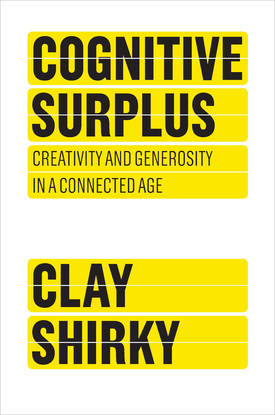
Clay Shirky; Cognitive Surplus
I picked up this book
on the premise that the subheading “Creativity and Generosity in a
Connected Age” would help me be more resourceful and productive. It
resulted in a fascinating read that I found myself bringing up in
conversation time and time again. I am not sure if I feel more
productive now I have finished, but I feel as thought I understand a little
bit better exactly why things they are a-changing.
Shirky writes in an
incredibly concise way, throwing in clear and enlightened insights
consistently, not only explaining how and why, but leaving your
thoughts reeling in the wake of what he has just said.
The story of Cognitive
Surplus covers just what we do with our free time since the occurance
of the big old world wide web. Previously us citizens were seen
simply as passive consumers of television, singularly and separately
in our spare time. With the revolutionary nature of the internet we
saw a change in this consumption. People began reaching for the
mouse, interacting, as pointed out by Shirky, through varied avenues
such as Lolcatz or couchsurfing to the communities of open source
technology programming. Shirky discusses how we use our free time and
how it has changed due to the burst of social media over the past few
years, now allowing interconnectivity on new levels.
For me, I felt my eyes
sparkle. What if it's true, and all of this free time can result in a
better, more communal society? At the moment, in the UK and across
Europe, and even the world, we are seeing financial crisis' left
right and centre. Younger and older people alike are finding
themselves jobless. Under 25 employment is at a record high in the
UK. And all of these young people have grown up in the age of the
internet, watching the technological revolution unfold. We have
already seen the importance of social media in various uprisings
across the world; from the revolution in Egypt to the formation of
Occupy globally. The internet, and more specifically social media is
becoming integral in organising human beings into value laden action.
Perhaps now we will
see a further politicisation of the younger generations; those sat at
home, jobless, full of fury and promise, constantly reaching for the
mouse to see what can be done.
17.2.12
Utopian pathways
Paths Through Utopias from Ed Murphy on Vimeo.
I encountered upon this documentary when I was looking through the listings of my favourite independent cinema in the world, in my hometown of Bristol; the cube.
It seemed like the embodiment of some conversations that gt and I have been having of late, concerning the relationship between activism and living life the way in which you believe; how you hold your values.
Turns out it is much more than that. It is beautiful, sentimental, critical and inspiring.
But I won't say any more, because you might not want what I want. But then again- you might.
Highly recommended.
Subscribe to:
Posts (Atom)