Showing posts with label books. Show all posts

6.5.15

faraway nearby

"Like many others who turned into writers, I disappeared into books when I was very young, disappeared into them like someone running into the woods. What surprised and still surprises me is that there was another side to the forest of stories and the solitude, that I came out the other side and met people there.
 Writers are solitaries by vocation and necessity. I sometimes think the test is not so much talent, which is not as rare as people think, but purpose or vocation, which manifests in part as the ability to endure a lot of solitude and keep working. Before writers are writers they are readers, living in books, through books, in the lives of others that are also the heads of others, in that act that is so intimate and yet so alone."


Rebecca Solnit - The Faraway Nearby

9.9.14

Franz Kafka

"I think we ought to read only the kind of books that wound and stab us. If the book we are reading doesn't wake us up with a blow on the head, what are we reading it for? ...we need the books that affect us like a disaster, that grieve us deeply, like the death of someone we loved more than ourselves, like being banished into forests far from everyone, like a suicide. A book must be the axe for the frozen sea inside us."

9.2.14

secret books in eden

"But Tom got into a book, crawled and grovelled between the covers, tunneled in like a mole among the thoughts, and came up with the book all over his face and hands."

- John Steinbeck, East of Eden

East of Eden

"Sometimes a kind of glory lights up the mind of a man. It happens to nearly everyone. You can feel it growing or preparing like a fuse burning toward dynamite. It is a feeling in the stomach, a delight of the nerves, of the forearms. The skin tastes the air, and every deep drawn breath is sweet. Its beginning has the pleasure of a deep stretching yawn. It flashes in the brain and the whole world glows outside your eyes. A man may have lived all of his life in the gray, and the land and trees of him dark and somber. The events, even the important ones, may have trooped by faceless and pale. And then - the glory - so that a cricket song sweetens his ears, the smell of the earth rises chanting to his nose, and dappling light under a tree blesses his eyes. Then a man pours outward, a torrent of him, and yet he is not diminished by the quality and number of his glories. It is a lonely thing but it relates us to the world. It is the mother of all creativeness and it sets each man separate from all other men. 

 I don't know how it will be in the years to come. There are monstrous changes taking place in the world, forces shaping a future whose face we do not know. Some of these forces seem evil to us, perhaps not in themselves but because their tendency is to eliminate other things we hold good. It is true that two men can lift a bigger stone than one man. A group can build automobiles quicker and better than one man, and bread from a huge factory is cheaper and more uniform. When our food and clothing and housing all are born in the complication of mass production, mass method is bound to get into our thinking and eliminate all other thinking. In our time mass or collective production has entered our economics, our politics, and even our religion, so that some nations have substituted the idea collective for the idea of God. This in my time is the danger. There is great tension in the world, tension toward a breaking point, and men are unhappy and confused.

 At such a time it seems natural and good to me to ask myself these questions. What do I believe in? What must I fight for and what must I fight against?"

John Steinbeck, East of Eden, pub. 1952

10.2.13

Ali Smith

“She looked round the room at all the books on all the shelves. A closed book on a shelf sat there quietly, not saying anything.”

There but for the

5.1.13

books

A wee while ago I asked my friends which books I should read. They came back with an eclectic list - because obviously my friends read a lot of books and (hopefully) also have excellent taste. After whittling out all of the vague authors names-with-no-book-titles, and already-read gems, I now have myself a list. Initially I was going to conduct a Kinders Al Kinley inspired 2013 challenge for myself - but I just don't think I have his determination. (However he did contribute to this list - for which I am grateful). I have added one of my own which has been sat by my bed for many moons (Oh What a Carve Up) which was given to me by a good friend many many months ago. Sorry Jules. It is on a list now, so don't worry. 

I'm not going to make a foolish promise to read all of the books below. Come on. But I will use this is a go-to list. Expect reviews. short and sweet ones. Soon. (Hopefully).

So here you go. My to-reads. 


Margaret Atwood - oryx and crake
Paul Auster – Leviathan
Paul Auster - Mr Vertigo
Franco Berardi - The Soul at Work
Mikhil Bulgakov - Master and margarita
Camus - The Outsider
Camus - The Plague
Jonathan Coe – Oh What a Carve up.
Michael Cunningham - A Home at the end of the world
Jared Diamond - Collapse
Junot Diaz - Oscar Wao + Drown
Dickens - Great Expectations
Jim Dodge - Stone Junction
David Eagleman - Sum
Jeffery Eugenides - Middlesex
Fitzgerald – Gatsby
Robert Girardi - Madeleine's Ghost
Ursula Le Guin - The Dispossessed
Joseph Heller - Catch 22
Hemingway - For Whom the Bell Tolls
Frank Herbert - Dune series
Huxley - Brave New World
Jeroen Krabbe - The Discovery of Heaven
Primo Levi - If This is a Man
Marquez - The General In His Labyrinth
Marquez - 100 Years of Solitude
Last of the Savages - Jay McInernery
Czesław Miłosz - Captive Mind
Haruki Murakami - IQ 84
Alun Paton - Cry the Beloved Country
Mervyn Peake - Ghormenghast trilogy
Marge Piercy - Gone to Soldiers
Thomas Pynchon - Gravities Rainbow
Antione de Sant Exupery - The Little Prince
Salinger - Franny and Zoey
Marjane Satrapi – Persepolis
Rebecca Solnit - Extraordinary Communities that Arise in Disasters
John Steinbeck - East of Eden
Scarlett Thomas - End of Mr Y
Stefan Zweig - Chess Story

3.10.12

books


So lately I've been reading some books.

 Post-MA I'm finally reading all those highly recommended oh-my-days-you-would-adore-this-book type of books.

I started with Owen Jones' Chavs. This was good. In fact, it was so good I stole it from Oxford library (sorry - I was leaving Oxford and hadn't finished) gave it to a friend (who lives in Oxford so will inevitably return it, don't worry). It's one of those books that makes you continually nod and make affirmative noises out loud. Finally someone wrote a book saying all those things you've been thinking. About the working class, what it means to be middle class, what Thatcher the milk snatcher did all those years ago when we were wee. Each chapter could have been a whole book in and of itself - and it got reeeally interesting in the final chapters when the discussion around immigration and class was stirred up. Would love to see that issue covered in more depth. 

Second up was Paul Mason's Why it's Kicking Off Everywhere. Which at first hit my big cynical attitude with a resounding thud. But as the pages turned and I found myself never without it, the cynicism that began with my thinking Paul Mason was niave (in a profound niavity of my own) melted away, and I realised that actually he's right. Shit is kicking off everywhere - and like it or not, Shirky is right too. That big old internet and those lovely social media platforms are playing a huge role in changing society, protest and organisation. Big things are yet to come and the youth know how to use the technology to make it happen. An inspiring read. 

Third up Doris Lessings' The Good Terrorist. Now, this one got me so excruciatingly confused at what she was trying to say using harsh sterotypes and personality traits of a group of squatters in 80s London. I profoundly disliked this book - but I literally couldn't put it down. I read it in two days (granted I was bed bound at the time) and was hooked constantly and consistently. I don't know whether it was due to the sporadic nature of the main character Alice, or because I was itching to become furious at the next presumption that Lessing would make. Don't get me wrong- some aspects were really interesting; the gender roles, the relationships between the characters. But the context and the attitudes was infuriating. All squatters and squats are dysfunctional. Alternative forms of resistance such as direct action are conducted carelessly by people who don't know what they're doing. That ideologically this group of self-proclaimed communists were lost, because they just wanted to 'resist' society and fight the po-po... But I'm probably reflecting through red-tinted glasses, having felt consistently rubbed up the wrong way. 

However, all in all a good starting line-up of the shape of books to come. What will it be next?


3.6.12

history is a weapon

Today is the Queens big Jubilee party day.


And I don't want to talk about it.


I don't want to see another Union Jack rammed into my direct or periphery vision. I don't want to play any more. The whole unadulterated spectacle of manipulating subjects into believing they are civilians, masking harsh austerity measures with another royal escapade, dressing the event up in nationalism and patriotism and passing it off as what the people want/ need /can't live without. A big pretense to unite Benedict Andersons 'imagined community'; bringing together the sovereign with the modern nation state. Binding the state, the queen and the subject-come citizen in some kind of politically motivated forced capitalist marriage.


However, I will talk about what Jubilee really means. See point 4. 


ju·bi·lee n.
1.
a. A specially celebrated anniversary, especially a 50th anniversary.
b. The celebration of such an anniversary.
2. A season or an occasion of joyful celebration.
3. Jubilation; rejoicing.
4. often Jubilee Bible In the Hebrew Scriptures, a year of rest to be observed by the Israelites every 50th year, during which slaves were to be set free, alienated property restored to the former owners, and the lands left untilled.
5. often Jubilee Roman Catholic Church A year during which plenary indulgence may be obtained by the performance of certain pious acts.

So to celebrate I have been reading Howard Zinn's 'A Peoples History of the United States'. Sat here, with my eyes and ears firmly shut to the ringing imperialism of the royal family, I am reading horrific stories of massacre, of slavery, of racism. I am reading of the brutal and unrelenting acts of the 'pioneers' of the new world. Who, for Queen and country, transported Black African slaves from continent to continent, trading, abusing, branding, starving, suffocating and killing thousands upon thousands of human beings. 


"By 1800, 10 to 15 million blacks had been transported as slaves to the Americas, representing perhaps one-third of those originally seized in Africa. It is roughly estimated that Africa lost 50 million human beings to death and slavery in those centuries we call the beginnings of modern Western civilization, at the hands of slave traders and plantation owners in Western Europe and America, the countries deemed the most advanced in the world."

There is a lot to be said about slavery. There is a lot left unsaid concerning slavery. Coming from a city in the UK that reaped a substantial percentage of it's wealth from the slave trade makes me question the big gap we have in our historical education. The main trade of sugar cane, tobacco, rum and cocoa were all products of the slave trade. But slavery and empire are sidelined at school for a tempered history of the United States of America, the development of medicine and punishment and World War 2. Colonisation had barely entered my vocabulary until I started university aged 21. History is a weapon that can be used for many a purpose. And often, that purpose is to shield truth from the many, hegemonically blurring the line between subject and citizen until the current situation is accepted as truth. Common sense. What else could it possibly be?


History is a Weapon. Read more about it.


23.3.12

Surplus for change


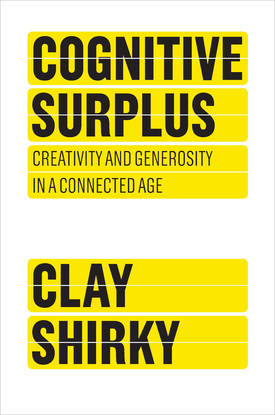
Clay Shirky; Cognitive Surplus

I picked up this book on the premise that the subheading “Creativity and Generosity in a Connected Age” would help me be more resourceful and productive. It resulted in a fascinating read that I found myself bringing up in conversation time and time again. I am not sure if I feel more productive now I have finished, but I feel as thought I understand a little bit better exactly why things they are a-changing.

Shirky writes in an incredibly concise way, throwing in clear and enlightened insights consistently, not only explaining how and why, but leaving your thoughts reeling in the wake of what he has just said.

The story of Cognitive Surplus covers just what we do with our free time since the occurance of the big old world wide web. Previously us citizens were seen simply as passive consumers of television, singularly and separately in our spare time. With the revolutionary nature of the internet we saw a change in this consumption. People began reaching for the mouse, interacting, as pointed out by Shirky, through varied avenues such as Lolcatz or couchsurfing to the communities of open source technology programming. Shirky discusses how we use our free time and how it has changed due to the burst of social media over the past few years, now allowing interconnectivity on new levels.

For me, I felt my eyes sparkle. What if it's true, and all of this free time can result in a better, more communal society? At the moment, in the UK and across Europe, and even the world, we are seeing financial crisis' left right and centre. Younger and older people alike are finding themselves jobless. Under 25 employment is at a record high in the UK. And all of these young people have grown up in the age of the internet, watching the technological revolution unfold. We have already seen the importance of social media in various uprisings across the world; from the revolution in Egypt to the formation of Occupy globally. The internet, and more specifically social media is becoming integral in organising human beings into value laden action.

Perhaps now we will see a further politicisation of the younger generations; those sat at home, jobless, full of fury and promise, constantly reaching for the mouse to see what can be done.  


25.11.11

ai wei wei

I have just finished a great little book: Ai Weiwei Speaks with Hans Ulrich Obrist


I want to write about it, but there is a milieu of things I could say about Ai weiwei. 
Mostly in regards to how the Chinese government have treated this 'dissident' earlier this year. But I will focus on this book as a window into the artist's mind. 


This little snippet of weiwei is fascinating. His personality is huge, the way he sees life is fluid and unique and he speaks with stark honesty. Especially in regards to China. 


weiwei's sunflower seeds was showing in the turbine hall of the Tate Modern when I started working there earlier this year. It is breathtaking. And the film that accompanies the installation is a beautiful story of how and why this piece came about. In fact, I almost liked it more than the tiny hand painted seeds themselves. 


I think the thing that makes weiwei so incredible is the way in which he sees the world. Art is an attitude, a way of thinking, or a way of life. His insights into the impact of the Chinese cultural revolution, his fathers experiences, his relationship with books and architecture and blogging are completely fascinating. 


"On the one hand I take art very seriously, but the production has never been so serious, and most of it is an ironic act. But anyhow, you need traces, you need people to be able to locate you, you have a responsibility to say what you have to say and to be wherever you should be. You're part of the misery and you can't make it more or less. You're still part of the whole fascinating condition here."


"And I have one regret: I feel sorry that I can't write well. That's the skill that I value the most. I think that, if I could write well, I'd give up my art for writing. For me, it is the most beautiful and effective way to illustrate my thinking"


Definitely worth a read. 


24.11.11

the human library

Last month a couple of friends and myself made a human library.

We were inspired by some discussion groups we had been holding for those on our MA and on our Indigenous Studies course. It was the most incredible experience to hear about some of my friends stories. Stories of difficult childhoods, indigenous struggles, living through war, having children, fighting against corrupt or oppressive regimes. Stories that could have gone untold, and many stories that needed to be shared.
It was an incredible experience for which I am hugely thankful. 


So we recruited some books from our group (and a few more from elsewhere), trained them, helped them identify their book titles and contents page and then put them on a shelf for others to browse and select.


 It was a great success by all means. 
 Some books were read 9 times in the 4 hours our library was open, over 50 people attended and all of the books (more or less) were returned in a healthy condition, buzzing from the experience of sharing their stories.


Here is a little video we put together for the event:


Many thanks out to everyone who took part in the event and all of the student groups and individuals that supported us. 
Not bad for two weeks notice. not bad at all. Well done team library!


Remember, don't judge a book by its cover... especially if it isn't a book. 

4.8.11

my new favourite book

I have always had a gentle fascination for books. I love stories, reading them, hearing them, writing them. But the format of a book. the heavy shape, the dry texture, the musty smell of library books... The way that physical books make me feel is quite something else as to the mystery worlds they hold beneath the covers.

Whilst working at the Tate I found this book, which the staff kindly gave to me as my leaving present. It is full of beautiful art crafted out of books. Gestalten's Book Art.

I know this may seem strange, as my friend gt once told me, it is heresy to hurt a book. And as I do have a profound love for books, then I should not condone the tampering of such special objects. But In this book the pages transform into something else. Just as I love to see letters and words taking different shapes and telling different stories to their usual form, some of the works of art in here are completely stunning. They are not destroyed, but transformed.

Here are a couple of mouth waterers:

Alicia Martin

Richard Wentworth

28.4.11

information


Over the past few months I have been working part time for an online political campaigning organisation. Through this work I have been impressed with how statisitcs can be tranformed into real life tangible information that can be used and manipulated to evidence certain things. Of course this is not new (see freakonomics, wordle and almost 2 years of writing statistical reports for Barnardo's after leaving university), but recently I have been falling in love with how beautiful this information can look.

And then, when at my paid job, I found this book: information is beautiful
Which hit the nail on the head.


It is full of beautiful diagrams and colourful charts of how information can be translated visually. And then I found a whole host of treats on the blog here. Including lots of things to play with.

This diagram is completely lovely: http://www.rhfoundation.org.uk/
(although perhaps the data not entirely interesting on a personal level)


Consequently I found myself sat on the tube reading a leftover guardian environment supplement which was completely full of lots of lovely numbers and visualisations. for more, try the guardian's datastore here.

I heart information.

17.2.11

freakonometry


I have recently finished reading 'Freakonomics' by Steven Levitt and Stephen Dubner. Which has now also become a documentary film.

It is one of those books I have seen kicking about for a while and I kept thinking that eventually I would get around to picking it up and reading it in a couple of sittings, like Gladwell's the 'Tipping Point' or 'Blink'. And true to my ideas, I found myself in Battersea library with some spare time and a new library card (Which I found painfully exciting... all those free books) and so decided this was the time. A new start at a new university, a new city, a new interest in economics (heightened by our change in government and the stronghold the economy has in determining the realisation of human rights) and so the time had come for this book.

And I have to admit is it extremely interesting- a little bit too neutral at some points, but able to show a side of data collection and analysis which makes me question every statistic that has ever been quoted before me. There are so many barriers and boundaries, so many correlating factors in the universe that attribute to a certain phenomenon, that it is nigh on impossible for a little left-winged student like myself to begin to grasp the ideas encompassed in this book. They did however, make me laugh out loud on the tube, smiling at the very ideas themselves and their blatancy.

It is very USA orientated, and very data heavy (of course) but the two Steve's have a magical way of explaining things without seeming condescending or over complicated, in a natural, lecturer to student kind of dynamic. They ask you to question what you thought you always new, and present you with a new, different way of looking at the links between different things... causality if you will. Which is very relevant in society today. After all, we are spoon fed things to believe in by the ever more conservative main streem media facets every single day. Why not question their angle?

The content you will have to judge for yourself, but the way in which the information is executed is fantastic and readable. The only problem is, I think it has planted a seed of doubt in my already cynical mind as to the nature of data and statistic gathering... so obscure and so dense, I honestly doubt I could see the trees for the woods.

bail ins

brilliant social media networking activism with a big grin and angry shout... tbc


4.10.10

hib & kika

off the map just brought me a big smile and a thought of a girl i know...

" We all have our own borders. On one side is what's easy, what's known, what we've been told is true and have taken for granted; it's comfortable here, it's familiar. But the other side is wider than possibility, it's brilliant with potential, and it looks like our dreams, whatever they are. Maybe for you that means having family or taking up sailing, maybe its poetry in Prague or solitude in Barcelona; maybe it's learning how to be really close to someone. Big or small, they are not the 'dreams' we've had handed to us, goodjob / bighouse / newcar - these are real dreams, real fragile fledgling dreams, which is why they're often so frightening. But they're ours, if we can find them and hold on to them, if we can catapult ourselves across whatever border of fear or doubt or tiredness seems to keep us from them. In the end, the only thing standing between each of us and what we most want, is ourselves. We're our own border guards. And sometimes the crossing is easier than expected..."

17.1.10

sacco


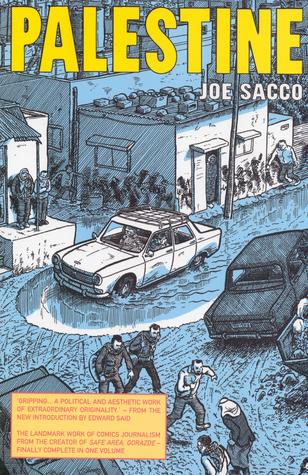
Ever since I came across Joe Sacco's 'Palestine', a graphic novel I borrowed from my friend Hannah, I have been in awe of the ability of Sacco to translate in pictures the struggle of Palestine.

I took my time to read the novel, dipping in and out of its pages when I felt I had the time and energy to confront the situation in Palestine. As a medium I find the graphic novel impressive, as it not only has words (and quotes of real life people due to 'Palestines' nature as a documentation of experiences), but it shows faces and families and street scenes, bringing it all to the present because its not only engaging us through text, but also by the intense pictures allowing each page to come to life.

I finished reading Palestine a week before my trip to the West Bank. And I am so glad of this timing, for i can honestly say, hand on heart, that Sacco's representation of Palestine is completely accurate, even today. He argues himself in footnotes that the struggle is timeless, as it has no conclusion, no outcome. It is continuous. The way in which he describes his experience of being a journalist within the daily naturalization of violence and suffering, until you realise every family has a story, every son has a brother in prison, every mother has lost a son or nephew to the struggle, the nature of every story and the changing reaction of the listener is documented so perfectly in Sacco's book. It becomes 'normal' to hear of martyrs and settler attacks and imprisonment without reason.

For Christmas this year I received Sacco's most recent work 'Footnotes from Gaza'. Ironically I also gave this graphic novel as a present to the very same friend... And again, I find myself taking my time to work my way through the chapters, as each page deserves attention to the detailed drawings and experiences being discussed scene by scene.

but read it for yourself.

and if you need more persuasion, here is an article on Al-Jazeera with Sacco himself.

Interview: Joe Sacco by Laila El-Haddad


22.11.09

nonel and vovel


this year for my birthday my mum gave me this comic book:

The Novel of nonel and vovel...


It is a book that is a result of a collaboration of two women: one Palestinian and one Israeli.

It is refreshing to see an equal collaboration between two creative sparks. resulting not only in a book, but also exhibitions, talks and tours facilitating a space to talk about creativity, art and most poignantly- the conflict in the middle east.

well done mum.

23.9.09

choose


choose what you read

A lovely idea borne from the commuter life in the big smoke.
Some lovely people wiht a lust for good books turn up every first monday of the month outside charing cross station (and other london stations) bearing a big sign and a big box of books allowing you to disregard that dull, bemusing metro you get shoved into your face each morning, and replace its position between your hands with a fantastic novel on any matter of subjects.

A little quote from the librarians:
The Librarians
Choose What You Read is our reaction to the tonnes of free newspapers dished out and thrown away every day. We'd like to give you the opportunity to read a book instead, donated by the public, to go back out into the public once finished. We’d like to give you the opportunity to choose a novel over a free paper. We love reading, we’re pretty sure you do too. Thank you for reading.
get involved, pick up a book, read it, send it back, then help yourself to another book.. what a wonderful world.

hopefully coming to a city near you soon...


31.8.09

naive. super


Naive. Super is a book by Erland Loe which I have just finished approximately 30 seconds ago.

I really would not know how to describe this novel. I have found myself talking about it copiously with my friends- telling little snippets and ideas, (of which there are many) but as a 'good read' it really is quite dry and bland and a little like hearing the inner monologue of a man close to depression.
It is a Norwegien book and weirdly, having been to Norway last year, I feel that fact on its own explains alot about this book. the clarity, the straightforwardness and the linear feeling of the narrative... I'm not sure how this correlates with the country of Norway.. but I find it is also very straightforward and simple and beautiful. Like the ideas contained within this novel.

The narrator is completely endearing. He has a wonderful way of saying things when he thinks them and wants to share his thoughts with other people. He moves to his brothers apartment, meets a boy, faxes his friend, reads a book on space and time, buys a ball, a hammer and nail toy, rides his bike and visits New York. Being perilously close to turning 25 myself (which was the pinnicle of the narrators leaving university and losing his sense of being) I felt as though this book brought something extra in to my life. I suddenly wanted to go and buy a ball, to bounce it against a wall and stop thinking about direction/meaning/purpose/time...
But instead, as the narrator does in the book, I decided to write a list of things that made me happy and a list of things that made me happy as a child. I love that lists were so prevalent in this book. I feel as though lists are extremely prevalent in my own every day life. my bedroom floor is littered with them, my desk at work is covered with tiny post it lists, every notebook i own has repeated lists between their covers. I cant imagine a life without lists.

things that made me happy when i was young:

my friends
sleeping
cycling
my lego pirate ship
marbles
miniture things

giving inanimate objects personalities
long grass
climbing trees

my piano
scary stories
horses
my school of stuffed toys
playing my recorder
cycling shorts
tie dye
reading books
writing stories
maths
drawing
colouring in
swimming in the sea
my dogs and cats
bare feet
bonfires
snow
sunshine
tom and jerry
pineapple
dancing

things that make me happy now:


my friends
my boyfriend
swimming in the sea
climbing ropes
trapeze
cycling
learning
scarves
reading books
music
seeing foxes in the city
making strangers smile
mountains
new places
sunshine
drawing
bare feet
fires
letters
snow
pineapple
dancing
big windows
woolly jumpers
art

tents
hot cross buns
really long emails/letters about important things
hugs hello and goodbye
laughing out loud
Bristol


I have also discovered that for me- it is not bouncing a ball that makes me happy, it is climbing onto trapezes and ropes to swing around in the air.
loveliness.